


Why I Built Articles Into Sxgram
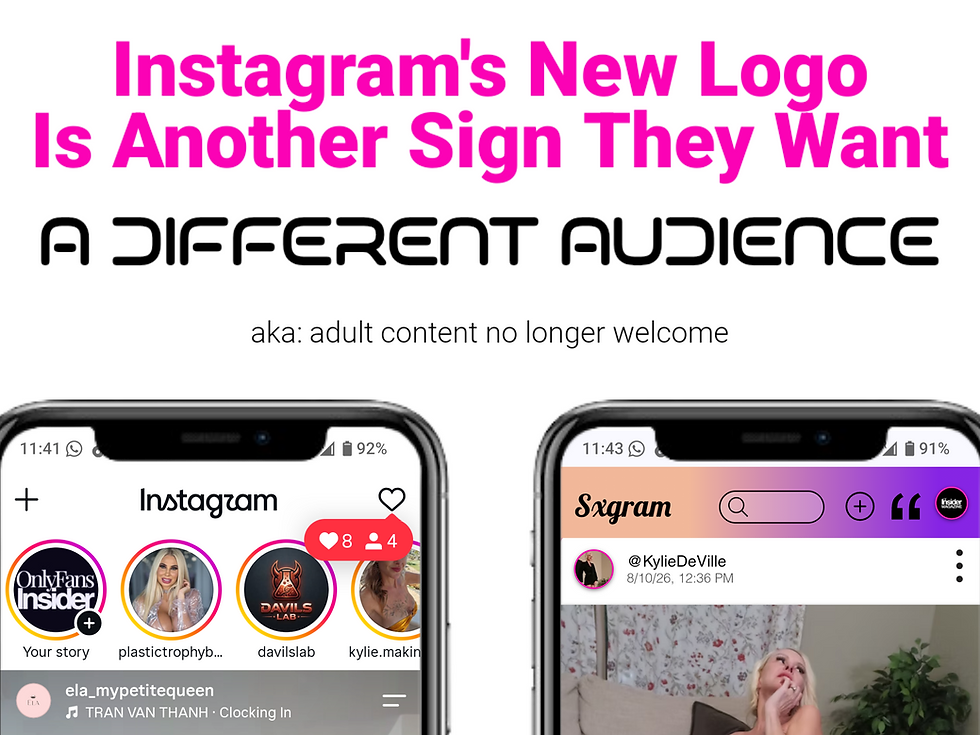
The adult ecosystem does not need another workaround. It needs its own social center.
By Joseph Haecker, Founder of Sxgram.com
For years, the adult creator economy has been building businesses on social networks that were never built for it. Sex workers and spicy creators went to Instagram, X, Snapchat, Facebook, Reddit and eventually LinkedIn because that was where the audience already was. The strategy seemed logical:
build a following on mainstream social media, develop a fan base, and then move some percentage of those people toward the platforms where creators could actually make money.
There was just one fundamental problem with that strategy. Those platforms were never their home. Sex workers were effectively building businesses on rented digital property where the landlord could change the rules, reduce discovery, restrict content, remove an account or decide that an entire category of conversation created too much risk. Academic research has documented sex workers describing exactly this struggle for visibility, including account deletion, shadow banning and the constant need to adapt their behavior to avoid moderation systems.
The policies themselves make the tension visible. Snapchat prohibits pornography and offers of sexual services, including online sexual subscription services, while its recommendation rules can deny amplification even to suggestive content directing someone to another account or website. LinkedIn removes nudity and sexual activity, prohibits content facilitating access to sexually gratifying material, and can limit visibility, remove content or restrict accounts for policy violations.
X is more permissive and currently allows consensually produced adult content when properly labeled, while Reddit gates mature content to adults. But neither fact changes the larger structural problem:
The adult ecosystem is still depending on general-purpose platforms whose priorities, moderation systems and business models were not designed around the success of this industry. Even where participation is permitted, permission is not the same thing as having a platform built around your economic and professional needs.
And that is only half of the problem.

There Is Another Adult Ecosystem Hiding in Plain Sight
When people hear “adult industry,” they often immediately picture the creators. They see OnlyFans accounts, spicy creators, cam models, performers and sex workers, because that is the most visible consumer-facing part of the ecosystem. But surrounding those creators is an enormous professional ecosystem that has almost nothing to do with posting explicit content.
There are therapists discussing intimacy and relationships. There are sexual-health educators, physicians, researchers, attorneys, coaches, SexTech founders, software developers, payment professionals, agency owners, investors and entrepreneurs discussing AI, legislation, funding, technology, safety, physical health, mental health and the future of human sexuality. These aren't fringe conversations; they are legitimate professional, academic, medical and commercial conversations taking place inside a very real economy.
Those people naturally gravitated toward platforms like LinkedIn, Medium, Instagram and Facebook because those were supposedly the places for professional networking, long-form ideas and business thought leadership. A founder could discuss fundraising on LinkedIn, a therapist could educate an audience on Instagram, a researcher could explain sexual health, and a SexTech entrepreneur could write a long-form essay on Medium. In theory, the professional side of the adult ecosystem had somewhere to go even if sex workers themselves remained marginalized.
Here is the dirty little secret: those platforms have failed this side of the ecosystem, too.
Research into Meta's moderation has found that the problem extends beyond pornography or commercial sex. A peer-reviewed case study of sex education on Meta concluded that restrictive and opaque moderation practices impeded distribution of sex-education material, while research involving healthcare providers and accredited sexual-health educators found that moderation restricted their ability to distribute medically accurate sexual and reproductive health information.
Research involving marginalized Instagram creators has documented experiences among people working in LGBTQ+ sex education, trauma-informed care, beauty and body politics, with participants reporting blocking, banning or deletion they believed was discriminatory. Another qualitative study of queer Instagram users found that participants experienced sexual-content moderation as limiting queer self-expression. This is not merely a sex-worker complaint; researchers are finding the effects across education, health, art, gender, sexuality and marginalized communities.
A 2025 study of malicious flagging makes the overlap particularly clear. It identified users dealing with deletions and deplatforming across sex work, art, activism, queer expression, mental-health advocacy and sexual-health education, and argued that opaque moderation systems can amplify attempts to silence already-stigmatized people.
That matters enormously.
The Algorithm Does Not Understand Your Résumé
A therapist can use the word “sex” because she is helping a couple repair their marriage. A physician can discuss a body part because she is explaining health. A founder can discuss pornography because he is building compliance technology for an adult platform, while an attorney can discuss sex work because she is analyzing legislation that could affect thousands of people's livelihoods.
The intention, expertise and context can be completely different. Yet automated moderation systems operate at enormous scale, and platforms establish broad policies around sexual content because they are balancing safety, minors, advertisers, legal exposure and their own definitions of what belongs on the service. The result is an ecosystem in which professionals can find themselves continually thinking about not only what they want to say, but how a platform might interpret them saying it.
LinkedIn is a particularly revealing example because it explicitly allows broad conversations about work and acknowledges that some adult nudity relevant to professional conversations may be permitted when it is not gratuitous. At the same time, its adult-content policy prohibits sexual activity and content that depicts, describes or facilitates access to sexually gratifying material. LinkedIn also relies on both trained reviewers and automated systems to identify potentially violating content.
Medium likewise prohibits pornographic images and videos, although it permits erotic writing and non-graphic erotic imagery. Snapchat goes considerably further in its public recommendation rules, stating that even moderately suggestive content directing users elsewhere can be denied amplification. Different platforms draw their lines differently, but the adult ecosystem remains the party expected to continuously understand, interpret and navigate those lines.
That is backwards.
We Have Split One Ecosystem Into Two Worlds
The unintended result is that we have spent years separating people who should probably know each other. The sex worker builds an audience on one set of platforms while the therapist, attorney, founder, investor and technologist conduct their “serious” conversations somewhere else. The creator understands the customer, the founder understands the technology, the attorney understands the regulation, the therapist understands the psychology, and the brand understands the product—but our digital infrastructure keeps fragmenting them.
Think about how strange that is from a business perspective. Adult creators are effectively an enormous distributed sales, media and consumer-insight network, while companies are simultaneously trying to understand creator commerce, affiliate marketing and influencer distribution. Sexual-wellness brands need creators, creators need additional monetization opportunities, technology companies need users, creators need better technology, researchers need lived experience, and the people writing laws need to understand the people those laws actually affect.
Yet the people with complementary knowledge are often building audiences in completely different rooms.
The problem isn't simply censorship. The problem is fragmentation. An ecosystem cannot mature efficiently when its performers, entrepreneurs, educators, technologists, brands and thought leaders are continually pushed into separate digital identities and separate conversations.
That is the part I think social media has fundamentally failed to solve.
Why Sxgram Needed Articles
When I started building Sxgram, I knew I didn't want to build another adult-content subscription platform. The world already has platforms where creators can monetize subscriptions and premium content. What I believed was missing was the social layer around the adult ecosystem—the place where people could discover one another, communicate, build audiences, share ideas, find businesses, develop professional relationships and create opportunities.
That is why Sxgram has Posts, Stories and Reels, but it is also why I insisted on building Articles.
Articles are our long-form publishing layer. I wanted a SexTech founder to be able to explain where AI is taking the industry without reducing the argument to a caption, a therapist to write thoughtfully about intimacy and mental health, and an attorney to explain legislation in enough depth for people to actually understand it. I wanted founders to discuss funding, creators to write about the business behind their careers, coaches to teach, researchers to share ideas, platforms to publish company news, and people with real expertise to develop a body of thought leadership around their names.
Because adults don't only communicate in photos.
Adults have ideas. Adults build companies. Adults debate laws. Adults discuss health, money, relationships, sexuality, technology and culture. A social network designed around adult life needs enough intellectual room for those conversations to exist alongside the social content, rather than forcing the people having them to leave the ecosystem every time they want to say something substantive.
That is the purpose of Articles on Sxgram.
Sex Workers and Thought Leaders Belong in the Same Room
I think this is where people can misunderstand what I mean when I call Sxgram “Social Media for Adults.” It doesn't mean that everyone on Sxgram creates adult content, and it certainly doesn't mean every conversation needs to be about sex. It means adults should have a social environment capable of acknowledging that adult identity is broader and more complicated than the sanitized fragments mainstream networks have trained us to present.
Someone can be a CEO and a sexual person. Someone can be a sex worker and an extraordinary entrepreneur, while a therapist can discuss sexuality and still be a serious professional. A creator can talk about subscriptions in one conversation and artificial intelligence in another, and a sexual-wellness founder can discuss venture capital, product design, orgasms, regulation and customer acquisition without pretending those subjects belong to completely different versions of themselves.
More importantly, those people should be able to find one another.
Imagine a creator reading an Article from a brand explaining its affiliate program and realizing there is a new revenue opportunity. Imagine a founder reading a creator's perspective on platform safety before designing the next feature, or a therapist publishing an Article that changes how thousands of creators think about mental health and burnout. Imagine an attorney explaining a proposed law directly to the people whose businesses could be affected by it.
That is an ecosystem behaving like an ecosystem.
The Adult Industry Doesn't Need Permission. It Needs Infrastructure.
For too long, this industry has responded to mainstream-platform restrictions by becoming exceptionally good at workarounds. Creators learn which words to avoid, which images might survive moderation, which links create problems, how to spell certain words differently, where to redirect followers, and how to rebuild when an account disappears. Researchers have even documented the emergence of these kinds of “algorithmic folk remedies” among queer users attempting to avoid demonetization, shadowbanning and deplatforming.
I don't want the next generation of this ecosystem to become even better at hiding.
I want us to become better at building.
That means building our own audiences, media, professional networks, discovery systems, commerce infrastructure, brands and institutions. It means giving a creator somewhere to publish next to the founder building the technology they use, giving a sexual-health professional somewhere to teach next to the community that needs that knowledge, and giving companies somewhere to participate without pretending their industry doesn't exist.
This is bigger than creating another place to post.
We Needed Our Own Social Center
The adult ecosystem has been scattered across the internet for years. Creators went wherever they could find fans, professionals went wherever they could establish credibility, founders went wherever investors and peers congregated, and everyone learned to adapt themselves to platforms built around somebody else's definition of acceptable conversation. The ecosystem became enormous without ever developing a true digital town square of its own.
I think that has held us back.
We need a place where the creator, therapist, coach, physician, founder, brand, attorney, technologist, investor, educator and fan can exist inside the same network. We need short-form discovery and long-form thought leadership, social interaction and professional networking, media and commerce, personality and expertise. Most importantly, we need an environment that begins with the premise that adults are capable of having adult conversations.
That is why I built Articles into Sxgram. It is also why I built Sxgram in the first place.
The other platforms have had years to make room for this ecosystem, and the research increasingly documents what many people inside it have experienced firsthand: moderation around sexuality does not stop neatly at the boundary between pornography and legitimate education, health, art, identity or professional discussion.
So I'm no longer interested in asking mainstream social networks to become something they were never designed to be.
I'm interested in building what they failed to build.
Sxgram.com - Social Media for Adults.


Comments