


Instagram Just Changed Its Logo. Adult Creators Should Pay Attention to What Else Is Changing.
The new Instagram wordmark may look playful. The platform behind it is becoming anything but.
Instagram has a new look. For the first time in roughly a decade, the platform has redesigned its familiar wordmark — the rainbow camera icon stays, but the cursive script users have known for years is now a cleaner, more contemporary hybrid of handwriting and print.
Instagram head Adam Mosseri kept the explanation simple: the wordmark hadn't changed in ten years, so it was time for a refresh — something cleaner and more modern, while still nodding to the app's original character and craftsmanship.
The reaction has been predictable. Some like it. Some hate it. Plenty of people think it reads closer to "Instagzam." Design forums have spent days dissecting the letterforms, the stroke weight, the slight lean of the "g." Marketing accounts have already turned it into a meme format.
But whether you like the typography is the least interesting thing about this change.
For creators — particularly those working in adult entertainment, sexual wellness, nightlife, and other mature industries — the more useful question is: what does the Instagram of 2026 actually want to be?
Because Instagram isn't the rebellious little photo-sharing app anymore. And adult creators shouldn't mistake a playful new signature for a return to the old Instagram.
A Brief History of What Instagram Used to Be
It's worth remembering what Instagram was competing for when it first built its identity. In its early years, Instagram and Snapchat were fighting over essentially the same cultural territory: young people, spontaneity, mobile creativity, visual communication, imperfection, fun. Instagram's original cursive wordmark and camera icon were part of that pitch — a scrappy, expressive, slightly rough-edged alternative to more corporate social platforms.
When Instagram launched Stories in 2016, the resemblance to Snapchat was so obvious that Instagram cofounder Kevin Systrom openly credited Snapchat with originating the format. Stories imported the disappearing, informal, everyday sharing behavior that had made Snapchat culturally important, and for a while, Instagram genuinely felt like a continuation of that same youthful, unpolished energy.
That was ten years ago. Instagram today occupies a dramatically different position. It's part of Meta. It is simultaneously a creator platform, an advertising machine, a shopping surface, a messaging product, a video platform, a recommendation engine, and one of the largest mainstream social networks on Earth. That evolution matters, because successful platforms eventually have to decide what — and whom — they are optimizing for. Instagram is increasingly telling us what its answer is.
The Logo Isn't the Evidence — the Policy Is
To be precise about the argument here: the redesign itself doesn't prove anything about Instagram's appetite for adult content. It's a typeface update. Reading corporate intent into kerning is a stretch, and treating it as a smoking gun would be lazy analysis dressed up as insight.
The real evidence is underneath the branding, in how Instagram actually treats content — and that evidence has been accumulating for years, well before anyone touched the wordmark.
Meta has spent years making Instagram more controlled and age-segmented. In 2026 it expanded a revamped Teen Account experience internationally, aiming to give under-18 users an experience roughly comparable to content appropriate for a 13-year-old — including stronger restrictions around sexually suggestive material. That's not a minor tweak to a settings menu; it's an architectural decision about what the default Instagram experience is supposed to look and feel like for a huge share of its user base.
But the more important implication isn't about content that outright violates the rules. It's about content that's allowed but not promoted.
Instagram is explicit that some content can remain on the platform while being ineligible — or less eligible — for recommendation. Among the categories it names as potentially sensitive: sexually explicit or suggestive material, and content promoting certain adult products and services. This is sometimes called "borderline content" policy in the broader industry, and it's become one of the most consequential — and least visible — levers a platform has.
That distinction matters enormously for creators, because there are really two different questions:
"Am I allowed to post this?"
"Will Instagram help anyone find it?"
Those are not the same question, and conflating them is where a lot of creators get blindsided. A business can technically exist on a platform in good standing — no strikes, no takedowns, no bans — while discovering that the systems responsible for audience growth simply aren't built to distribute what it publishes. The account survives. The growth doesn't.
Instagram Doesn't Have to Ban You to Make Building a Business There Difficult
This is where the conversation about adult creators usually gets flattened. People ask: "Does Instagram allow adult creators?" That's close to the wrong question, because the binary of allowed-or-banned isn't how modern recommendation systems actually work.
A creator's livelihood doesn't depend on merely being permitted to keep an account. It depends on discovery, reach, links, audience development, brand building, customer acquisition, community, and ultimately conversion. Every one of those depends on some algorithmic system deciding to surface your content to someone who hasn't already sought you out.
An account that exists but can't reliably participate in those systems has a fundamentally different economic value than one operating inside the platform's preferred content ecosystem. It might post consistently, follow every guideline to the letter, and still watch its reach flatline — not because of a single violation, but because the recommendation engine was never built with that account's category in mind.
For adult creators, that gap should matter far more than whether the "Post" button still works. A working post button with no distribution is a business slowly running out of oxygen, just more quietly than an outright ban.
Don't Let the New Logo Fool You
There's a real contradiction in Instagram's new identity. The wordmark itself feels handmade, expressive, individual — CreativeBloq reports the brand language around the redesign leans on ideas like creativity, connection, individuality, and personal expression. Those ideas sound creator-friendly on their face, and the marketing language around any rebrand is designed to feel warm and inviting.
An adult creator glancing at the refreshed Instagram might reasonably think: maybe this is Instagram trying to feel fun again. Maybe the pendulum is swinging back toward the looser, more expressive platform it used to be.
Maybe. But branding isn't platform strategy, and it's worth being skeptical of reading a typeface as a policy signal in either direction. Instagram can look more expressive in its visual identity while simultaneously getting more sophisticated about controlling which expressions it actually distributes — especially around younger audiences and sensitive content. Those two things aren't contradictory. A brand refresh is aimed at how the platform feels to the broadest possible audience; content and recommendation policy is aimed at what the platform actually does. Companies routinely soften the former while tightening the latter — it's a well-worn playbook, not a coincidence unique to Instagram.
Instagram Is Becoming More Like Facebook
Not visually. Structurally.
Instagram isn't simply a place where young people post interesting photos anymore. It's infrastructure: advertising, recommendations, brand safety, parental controls, age-appropriate experiences, regulatory pressure, massive advertisers, and billions of users with wildly different cultural expectations, spread across nearly every country and legal regime on Earth.
That's the same trajectory Facebook went through years earlier — from a scrappy, informal social network into a heavily governed, advertiser-driven, regulator-facing platform where content decisions are made with global brand safety and legal exposure in mind, not just user delight. Instagram has grown up in much the same way. That may be exactly what a platform its size should do; regulators, parents, and advertisers all have legitimate reasons to want a more predictable, controlled environment at that scale.
But adult creators need to understand what that maturation means for them specifically, separate from whether it's a reasonable thing for Instagram to do overall.
A global mainstream platform trying to simultaneously serve teenagers, parents, global brands, advertisers, and regulators will inevitably draw boundaries around what it considers broadly distributable — and adult businesses are unlikely to sit at the center of that equation. It's not personal, and it's not necessarily hostile. It's what happens when a platform's core incentives shift from "grow a young, engaged audience" to "keep a massive, diverse audience and the advertisers who pay to reach them comfortable at the same time."
Instagram doesn't need to announce "we don't want adult creators." Its product incentives can communicate something quieter: you may be able to exist here, but this ecosystem isn't being designed around your business. That's the distinction worth watching, and it's a distinction that shows up in reach numbers and discovery metrics long before it shows up in any public statement.
What This Actually Means for a Creator's Day-to-Day Strategy
If you're building an audience or a business that touches adult content, sexual wellness, nightlife, or anything Instagram might quietly classify as sensitive, the practical questions worth asking are different from the ones most creators default to.
Instead of just monitoring whether your account gets flagged or removed, it's worth paying attention to reach per post over time relative to follower count, whether your content is showing up in non-follower feeds like Explore or Reels recommendations, whether your links and bios are getting restricted even when the underlying content isn't, and whether your growth is increasingly dependent on paid promotion rather than organic discovery. A slow, steady decline in any of those is a far more reliable signal than a single post getting removed — and it's the kind of signal a logo redesign will never tell you anything about.
None of this means abandoning Instagram entirely is the right move for every creator. Plenty of businesses will keep using it as one channel among several, treating it as a place to maintain presence and drive traffic elsewhere rather than a place to build a primary audience. But treating it as the sole foundation of a business — especially one in a category Instagram is visibly deprioritizing — is a different level of risk than most creators price in.
The Logo Isn't the Story. The Direction Is.
Instagram's new wordmark will generate memes for a few weeks. People will argue about the typography, and eventually most will stop noticing it — that's what happens with almost every rebrand. In six months, it will simply be what Instagram's logo looks like, and nobody will remember the debate.
What's worth paying attention to is the larger transition happening underneath it. The Instagram that once competed with Snapchat for youthful cultural relevance has matured into one of the world's dominant mainstream media and advertising platforms. Its policies increasingly reflect the responsibilities, commercial incentives, and audience expectations that come with that position — expectations set by regulators, by advertisers, and by parents, not by the creators trying to build a living inside the platform.
That's not necessarily an indictment of Instagram. It's a reason to think carefully about depending on it.
If your livelihood depends on reaching an adult audience, promoting an adult business, or participating in the adult creator economy, it's worth asking: are you building somewhere that merely permits you to exist, or somewhere that actually wants your business to succeed? Are you tracking the metrics that would actually tell you the answer, or just watching to see whether your account is still standing?
The logo change alone doesn't answer that question. It never could. The direction of the platform does — and that direction has been visible for years to anyone watching the policies instead of the branding.
About Sxgram
The Anti-Instagram.
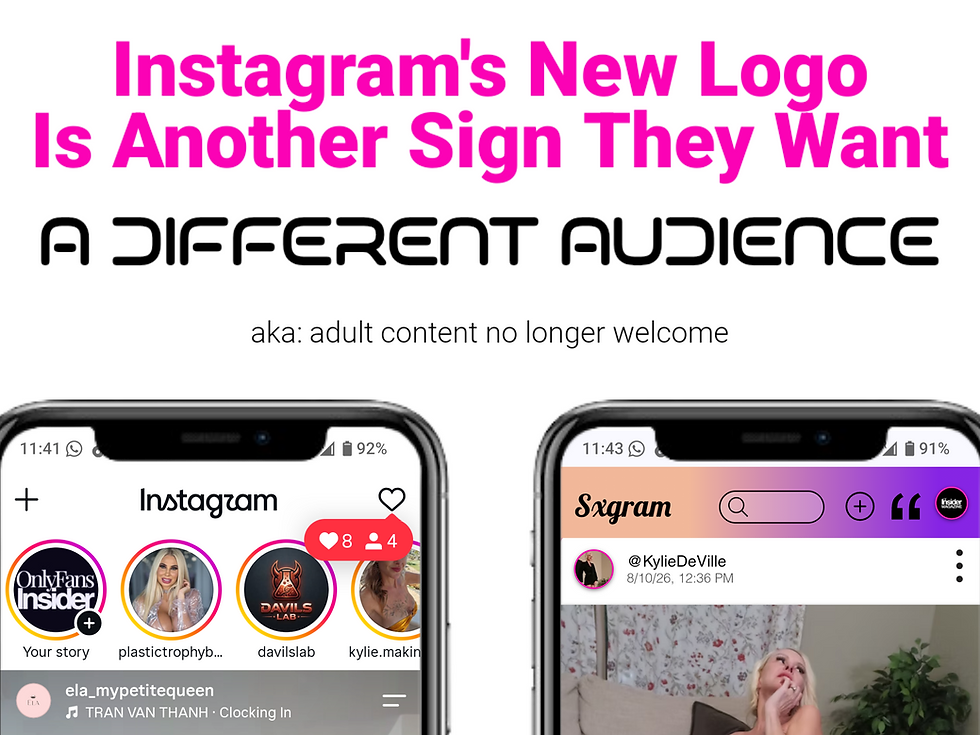
Sxgram is social media for adults—built for creators, influencers, entrepreneurs, and businesses that are tired of trying to build legitimate businesses inside platforms that seem increasingly uncomfortable with the industries they work in.
We believe in a simple idea:
If you operate a legal business, you should have the right to market and promote that business.
Sxgram is deliberately pro-business, anti-unnecessary restriction, and anti-Meta dependency.
We aren't interested in making creators rewrite their bios, disguise what they do, speak in code, remove legitimate business links, or spend years building an audience only to discover that a policy change has suddenly made that audience harder to reach.
And we don't believe creators should have to build their businesses around the question:
"Will Instagram allow this?"
We're Building the Alternative.
Sxgram takes the familiar social experience people already understand—profiles, followers, Grams, Stories, Reels, articles, likes, comments, messaging and discovery—and builds an ecosystem around the needs of adult creators and businesses.
But we're going further than social media.
We want Sxgram to become business infrastructure for the creator economy.
Creators can build an audience, establish their personal brand, publish longer-form content, direct followers toward the businesses and platforms they monetize, participate in our Affiliate Marketplace, earn through referrals, gain additional exposure through Sxgram Magazine, and use their Sxgram presence as another layer of their broader creator business.
The goal isn't to own every transaction a creator makes.
It's to help creators create more of them.
Your Audience. Your Business. More Ways to Earn.
Instagram has its priorities.
Meta has its priorities.
We have ours.
Sxgram exists to give adult creators and businesses a social ecosystem that starts with the assumption that their businesses are legitimate—not something that needs to be hidden.
We're not trying to become the next Instagram...We're building the anti-Instagram.
Less restriction.
More opportunity.
More ways to build.
More ways to earn.
Sxgram.com — social media for adults.


Comments